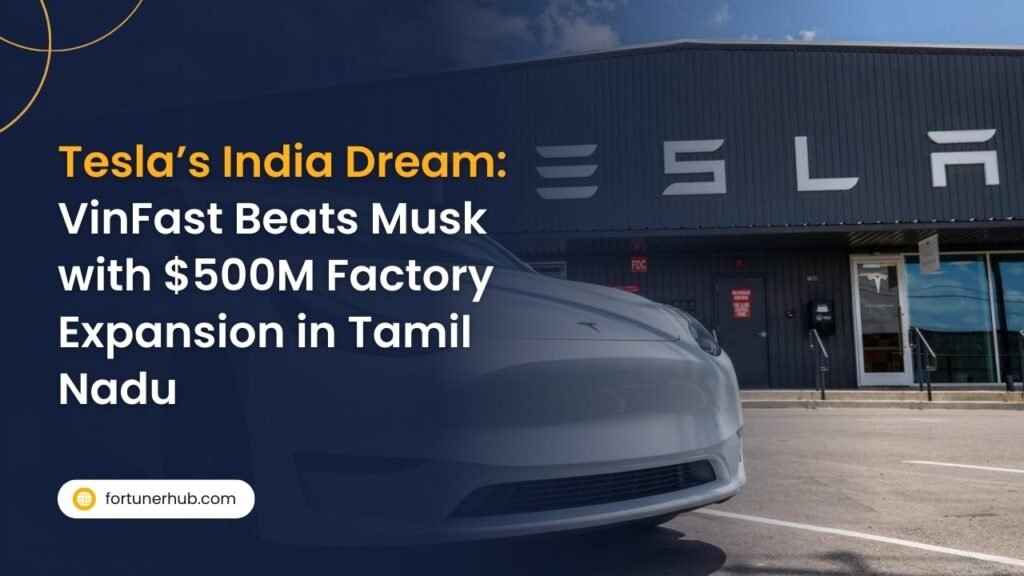
In what’s shaping up to be one of the most telling upsets in the global electric vehicle (EV) race this decade, Vietnamese automaker VinFast has leapfrogged Elon Musk’s Tesla in India, announcing a $500 million expansion of its EV manufacturing footprint in Tamil Nadu — a move that might well define the future of EV production in the world’s third-largest auto market.
VinFast’s latest move builds on its already operational Thootukudi assembly plant, which began production in 2025 and is part of a broader planned investment of up to $2 billion in India. The new expansion — formalised in a memorandum of understanding with the Tamil Nadu government — will add dedicated production lines for electric buses, e-scooters and supporting components, significantly broadening the company’s portfolio beyond its initial electric car models.
The state government has earmarked roughly 200 hectares of land adjacent to VinFast’s existing facility, part of an industrial park tailored for clean mobility manufacturing. Under the deal, VinFast’s incremental $500 million investment will unlock incentives and exemptions under Tamil Nadu’s industrial policy. Local officials have also backed improved infrastructure connectivity — from power supply to internal roads — to support the expanded operations.
“We believe Tamil Nadu will continue to serve as a strategic hub in our global expansion journey and support India’s green mobility goals,” said VinFast Asia CEO Pham Sanh Chau, underscoring the company’s commitment to localisation, job creation, and EV ecosystem growth.
VinFast’s factory already assembles its VF 6 and VF 7 SUVs, with an initial capacity of 50,000 vehicles per year, scalable up to 150,000 units as demand grows. The Tamil Nadu base is expected not only to serve domestic buyers but also to become an export hub targeting South Asia, the Middle East, and Africa — a strategic advantage Musk’s Tesla has yet to match.
Tesla’s Struggles in India
By contrast, Tesla’s entry into India has been measured and cautious. After years of anticipation, the American EV giant finally opened its first showrooms in Mumbai and Delhi in mid-2025 and began selling the Model Y at a premium price point — over $70,000 — largely due to India’s steep import duties on fully built vehicles.
Tesla’s sales traction has been slow. According to recent industry reports, the company sold only a few hundred vehicles in India during its first year of operations, even as it garnered modest bookings. High tariffs, limited charging infrastructure, and Tesla’s choice to continue imports rather than local manufacturing have dampened its market impact.
Government sources have also hinted that Tesla currently has no firm plans to build a local manufacturing plant, despite incentives that could lower import taxes if an automaker commits roughly $500 million to Indian production. Musk’s company has instead emphasised showroom launches and import-led sales.
Why VinFast Is Advancing Faster
Industry analysts say VinFast’s aggressive build-out is paying dividends precisely because of its local manufacturing strategy. India’s auto market — cost-sensitive and fiercely competitive — rewards localisation with lower costs, faster delivery, and proximity to a sprawling supplier ecosystem. VinFast’s focus on multiple vehicle segments — from cars to buses and scooters — also broadens its market reach.
With VinFast’s Tamil Nadu expansion now underway and poised to inject fresh momentum into India’s EV landscape, the once-clear narrative of Tesla as the undisputed EV leader is being rewritten — at least on the subcontinent. The next chapter in the global EV race may well be written not in Silicon Valley, but in South Asia.